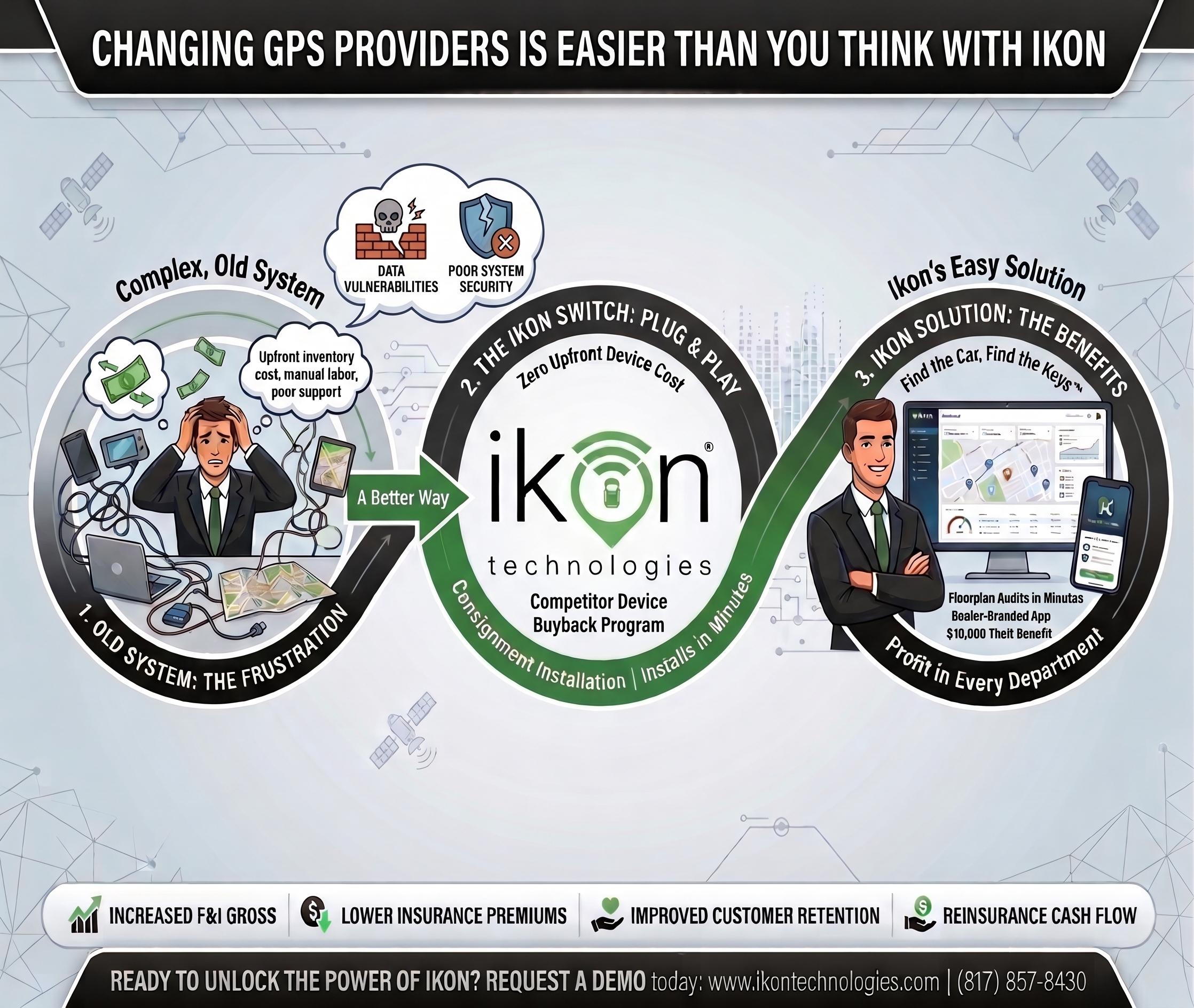
Our lineup runs across four connected solutions, Lot Management, Theft Recovery, Connected Car, and Smart Marketing, each tied to a department rather than sold as a loose gadget.
Here is why that matters. The same installed device does a different job as a unit moves from stock to sale to the service drive. On the lot it cuts the wait that keeps shoppers standing around. In F&I it gives your team a real product to put on the menu. On the back end it stops the first service appointment from leaking and hands accounting a cleaner audit trail. Knowing which tool lives in which office is honestly the difference between a clean rollout and one that stalls.
Read the lineup as an operating map of your store, not a brand sheet. Our four solutions, Lot Management, Theft Recovery, Connected Car, and Smart Marketing, each solve one departmental bottleneck while sharing the same hardware. Lot Management belongs to sales and lot ops. Theft Recovery sits with the GM and F&I as asset protection. Connected Car is the F&I product that follows the buyer home, and Smart Marketing runs out of the service BDC. Theft Recovery anchors the protection case, and we report a 99.8% recovery rate at an 18-minute average on our homepage as a company-measured result. For a fuller orientation, our breakdown of dealer-built telematics for lot ops walks the same ground, and the included solution set is laid out on the dealer site.
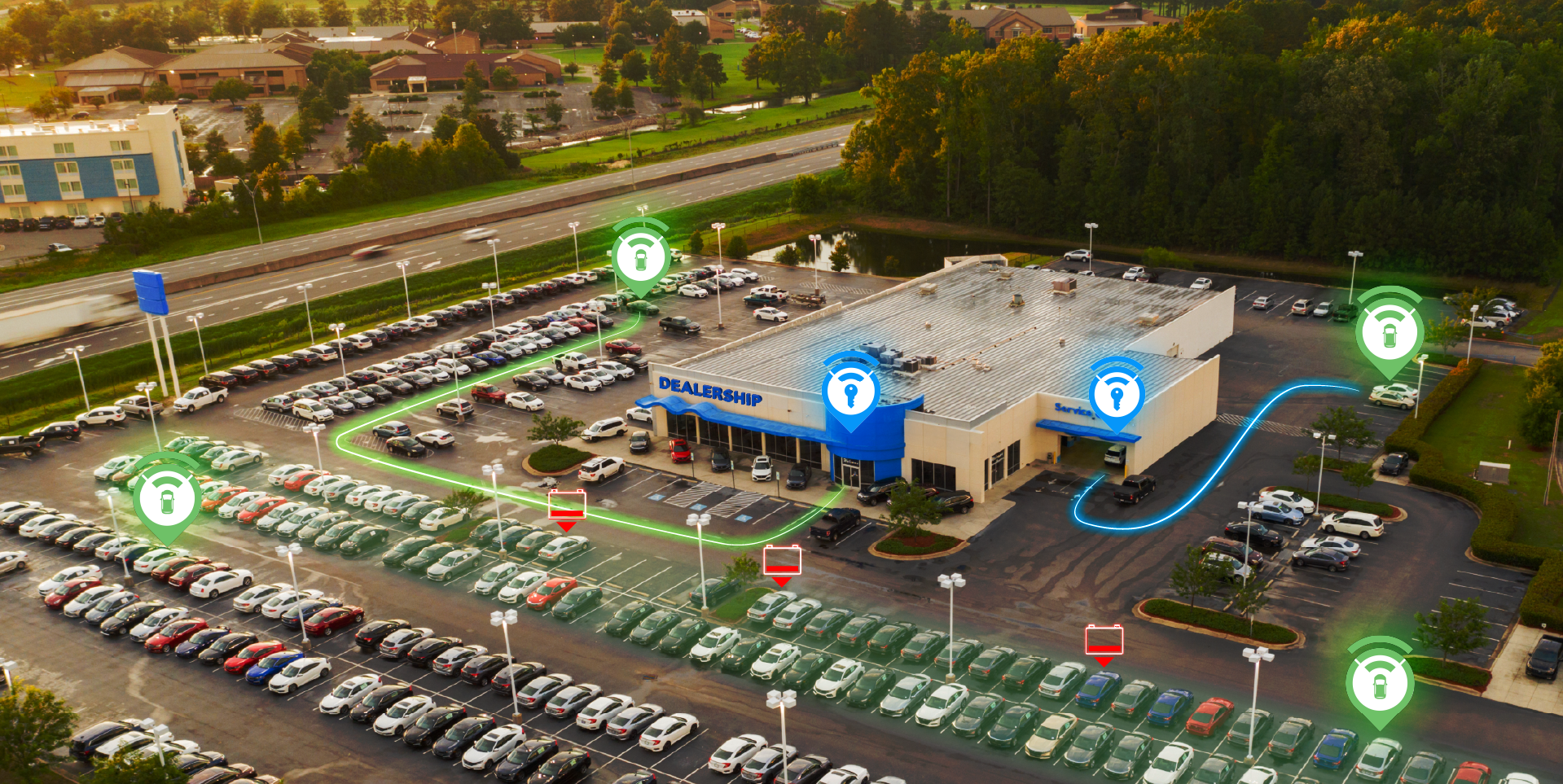
Lot Management shortens the path from "I want to see it" to a moving test drive by pinpointing the exact vehicle and its key in seconds. We report 15 minutes saved per sale through that workflow, and it lands because of the bottleneck it clears. CDK's 2025 Friction Points coverage found that 55% of shoppers waited on the test drive, and securing the right unit was named as a time-eater when cars sit in service, in remote overflow, or over at a sister store.
The system maps and locates vehicles and keys, sets geofences, flags dead batteries, tracks inventory aging, and runs floor audits. So instead of walking the rows, a salesperson on the Toolbox App pulls vehicle info straight from a phone. The Key Finder pairs a GPS-tagged unit with its tracked fob through Bluetooth gateways, which is exactly what closes the gap when the car turns up but the key does not. Battery, aging, and rotation alerts keep your front-line cars ready to show. Our deeper look at the find-the-car, find-the-keys workflow shows the porter and desk handoff in detail. And for leadership, that same data feed cuts physical audit time by a reported 56%, which is where accounting feels it.
The handoff happens at delivery: the same device that served lot ops becomes the buyer's dealer-branded Ikon Connect app. On the owner side, the Connect mobile app carries service reminders, Stolen Mode, speed alerts, battery alerts, geofences, and trip history. One thing to flag on the claim path: the app has to be downloaded within 24 hours of purchase, and after a police report the owner taps "Go to Stolen Mode" to kick off recovery support.
For F&I, that tangible utility is the whole pitch. We report a $323 plus wrap average PVR boost with a 0% cancellation rate, a $10,000 driver theft warranty benefit, and a 30% term-wrap rate, so the product can match the customer's loan or lease term right inside the menu. Pricing the system to the retail consumer stays at your reasonable discretion, with Ikon suggesting a typical market rate.
The boundary is the part to keep honest. We do not hand the dealer a sold customer's live vehicle location without a valid legal basis. The post-sale value for the rooftop is consented, mileage-based service engagement. With the FTC's connected-vehicle order requiring affirmative express consent to collect or share that data, drawing that disclosure line protects the store as much as the buyer.
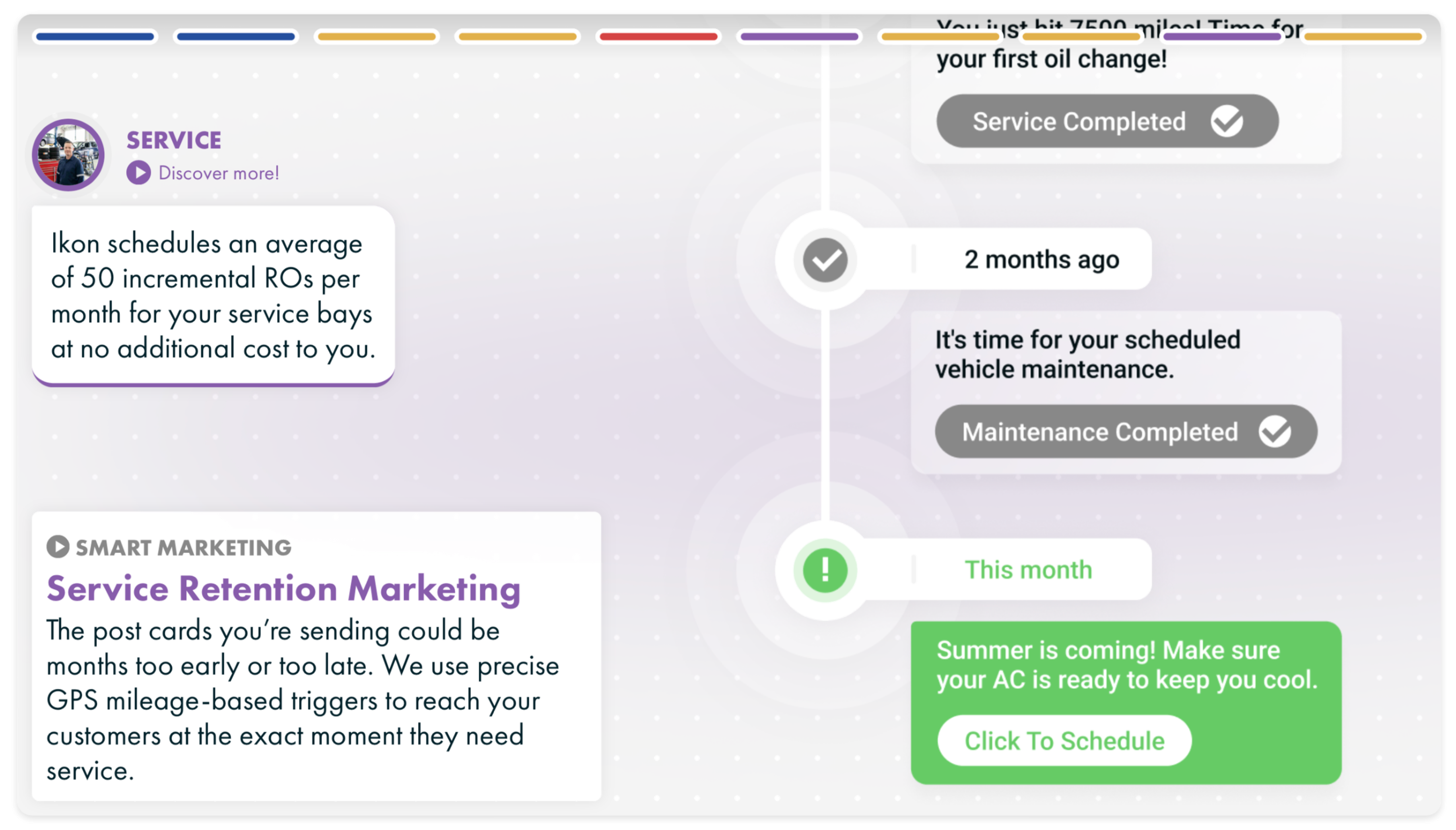
Smart Marketing protects fixed ops by firing dealer-branded service outreach off live mileage and routing the customer straight into your scheduler. The published process is concrete: it detects a VIN near a mileage trigger, sends a personalized text, routes to the dealer scheduler, follows with up to three reminders, then hands back appointment and click lists. We report 50+ incremental repair orders per month, a 32.7% appointment conversion, and 100% dealer-branded messaging, with those figures labeled as historical Ikon customer results rather than a promise for every store.
The leakage it targets is real money. Cox's fixed operations research shows that 80% of new buyers say they would likely service at the selling dealership, yet only 25% are introduced to service and just 23% leave with a first appointment booked. Buyers who do return for service repurchase at 74% versus 44% for those who don't, which turns that first appointment into a future sale. With dealership share of service visits sitting at 29% in 2025, down from 33% in 2018, Smart Marketing is the piece that pulls the sales-to-service loop closed using the same device you already installed on the lot.
Under consignment, devices land in your parts department at $0 upfront cost, Ikon keeps ownership, and you pay when a sale occurs rather than carrying hardware as inventory. The dealer agreement spells out the back-office mechanics: a read-only DMS link drives automated activation and deactivation on sold units, inventory reconciliation through a third-party feed, and billing accuracy, so the office stops double-keying. The agreement also references a 30% retail-purchaser threshold within 90 days of launch, which a controller should factor into the rollout math.
Two operational rules matter at the desk. When you trade or wholesale a unit, the device has to come out physically and get digitally uninstalled through the dealer portal, otherwise it keeps reconciling against a car you no longer own. And because authorized signals land inside your own workflow, the rooftop keeps control of that data without crossing the owner-location line.
The real decision is not whether to buy a GPS box. It is whether your store is ready to run a cross-department system where one device touches sales, F&I, service, and accounting all at once. Treat the evaluation by the bottleneck each product clears: the 15 minutes lost before a test drive, the leaking first service appointment, the inventory the office can't reconcile. Counting features misses the point.
Before you sit through a demo, assign the owner for each piece. The sales manager takes the lot workflow, F&I takes the Connect presentation, the service BDC takes the mileage scheduler, and the controller takes DMS activation and audits.
Then settle the disclosure question early, since the customer-facing app and any data promise are consent-sensitive. Walk those owners through one rollout review, and honestly, the conversation with us gets a lot shorter.
Lot Management, through the Find the Car, Find the Keys workflow. It pairs a GPS-tagged unit with its tracked fob over Bluetooth gateways, so any salesperson or porter pinpoints both in seconds from the Toolbox App. Ikon reports 15 minutes saved per sale, which keeps appointments and test drives moving.
The dealer-branded Connect app gives the owner six core functions: service reminders, Stolen Mode, speed alerts, battery alerts, geofences, and trip history. The customer can protect the vehicle, watch for over-speed or boundary events, and reach the service drive in one click, all under your store's brand rather than the manufacturer's.
Smart Marketing handles the mileage-triggered outreach. It detects a VIN near a mileage threshold, sends a personalized dealer-branded text, and routes the customer into your scheduler with up to three reminders. Ikon reports more than 50 incremental repair orders per month and a 32.7% appointment conversion, though those are company-reported results, not guarantees.
Ikon uses a read-only DMS integration, so it reads program data without writing into your system. That link drives automated activation and deactivation on sold vehicles, inventory reconciliation through a third-party feed, and billing accuracy. For accounting and operations, it means fewer manual entries and a cleaner match between what the DMS shows and what is actually installed.
When you trade or wholesale a vehicle, the device has to come out two ways. You physically pull the hardware from the car, and you digitally uninstall it through the dealer portal. Skip the digital step and the unit keeps reconciling against a vehicle you no longer own, so both actions are required to keep your inventory records accurate.
No. The dealer does not receive a sold customer's live vehicle location without a valid legal basis. The post-sale value for the rooftop is consented, mileage-based service engagement, not open-ended owner tracking. With the FTC requiring affirmative express consent for connected-vehicle data, that boundary keeps service-retention outreach separate from real-time surveillance.

.jpg)




.jpg)