.jpg)



.jpg)
For franchise car dealers and automotive groups, moving inventory is a foundational part of daily operations. Whether you are transferring vehicles between stores in your own network group, executing an inter-dealer trade to secure a specific vehicle, or arranging long-distance delivery directly to a consumer’s driveway, vehicle transport keeps the industry moving. Today, however, that critical logistics link has become a massive security risk.
Recent industry data highlights a staggering 1,400% increase in strategic cargo theft of vehicles. This isn't your traditional late-night lot raid. Criminals are shifting their focus to the transport phase, utilizing highly sophisticated, tech-driven schemes to intercept vehicles during transfers, trades, and home deliveries. Furthermore, this threat extends past commercial operations, impacting consumers who require peace of mind when personally transporting their own vehicles across the country.
Here is a breakdown of how this modern auto transport theft wave operates and the concrete steps businesses and consumers must take to secure vehicles in transit.
The Evolution of Strategic Cargo Theft in Vehicle Logistics
Historically, vehicle theft meant breaking a window or hotwiring a car on a lot. Today's syndicates operate more like corporate entities, exploiting the digital vulnerabilities of the automotive logistics network. Instead of using crowbars, they rely on identity theft, digital manipulation, and freight fraud to steal entire transport loads at a time.
1. The Use of Advanced Tech and Fake Identities
Criminals are no longer just tracking shipments - they are completely rewriting the digital identities of the logistics chain. Tech-savvy fraudsters aggressively use online phishing campaigns to trick legitimate carriers or dispatchers into revealing sensitive network credentials. Once inside the system, they spy on impending high-value vehicle moves, copy real shipment details, or take over transport accounts entirely.
2. Fraudulent Carriers and Carrier Ghosting
The most damaging tactic in modern transport theft is carrier misrepresentation. Sophisticated criminal networks establish fraudulent shell companies to secure standard operational credentials, including Federal Motor Carrier Safety Association (FMCSA) numbers and insurance policies. They use these credentials on digital freight boards to illegitimately bid on transport contracts.
In some instances, criminal networks buy out legitimate transportation firms from retiring owners simply to inherit their strong job histories and unblemished corporate reputations. Once they clear basic background checks and pick up the vehicles for a dealer trade or consumer delivery, the driver - and your inventory - vanishes.
3. Targeting Premium Inventory
Syndicates specifically hunt for highly expensive vehicles moving long distances. High-profile disappearances, such as a $171,562 Bentley Continental Flying Spur en route to Missouri and a $218,000 Ferrari Roma traveling from Colorado to Minnesota, underscore that thieves are selectively targeting premium, high-gross assets during transport.
The Multi-Layered Cost of Transport Logistics Disruption
The ripple effects of a 1,400% spike in transport theft extend far beyond the immediate loss of a single vehicle. The financial and operational fallout impacts every corner of the market:
- Complex Inter-Store and Inter-Dealer Litigation - When a vehicle vanishes between a sending lot and a receiving lot during an inter-dealer trade, resolving liability creates immense operational friction. The escalating prevalence of these scams forces automotive businesses into steep asset losses, severe retrieval costs, and costly legal disputes between stores.
- Failed Consumer Deliveries - In an era where long-distance digital buying is surging, telling a consumer their newly purchased vehicle was stolen off a transport truck during home delivery completely destroys brand loyalty and trust.
- Consumer Vulnerability - When individual vehicle owners need to transport their personal cars due to relocation or a long-distance sale, they face the exact same fraudulent carrier risks as major dealerships, often without the corporate resources to manage the fallout.
- Skyrocketing Insurance Premiums - As strategic cargo theft risks escalate, underwriters are raising premiums for vehicle transport and inventory coverage, cutting directly into dealership margins and raising costs for consumers.
Actionable Prevention Strategies for Transport Security
Vigilance alone is no longer enough. Dealerships, logistics managers, and consumers must implement aggressive, layered security protocols to safeguard vehicles during transport.
Tighten Verification Protocols at the Point of Transit
Never release inventory to a carrier without multi-factor verification. Require lot managers to verify the truck’s physical license plate against the dispatch paperwork. Industry platforms are adjusting to this need; for instance, some transport platforms have integrated mandatory biometric and government document identity verification for every platform user to mitigate baseline access risks.
Train Staff on Fraud Indicators
Train your logistics and receiving staff to recognize the red flags of freight fraud. Common warning signs include carriers requesting last-minute drop-off location changes, high-pressure demands to bypass standard check-in paperwork, or communication coming from generic email addresses rather than official corporate domains. Staff should also look out for suspicious dispatch volume discrepancies - such as a small carrier with minimal drivers trying to book multiple remote loads simultaneously across distant regions.
The Imperative of Secondary SVR Systems in Modern Automotive Logistics
When sophisticated criminal syndicates employ carrier fraud, standard logistics tracking is often the first line of defense to fail. Because professional thieves know how to locate and disable factory-installed navigation units or standard onboard diagnostics (OBD) trackers, relying solely on a single, highly predictable tracking layer means visibility over the asset terminates the moment the vehicle is diverted.
To achieve true supply chain resilience during dealer network transfers, inter-dealer trades, and long-distance consumer deliveries, prioritizing a secondary Stolen Vehicle Recovery (SVR) system is an absolute operational necessity. A secondary SVR system acts as a redundant, independent security perimeter that remains operational even after the primary defense line is compromised.
To effectively counter high-tech cargo theft, a resilient secondary vehicle recovery system must rely on a specific engineering profile:
Covert Hardware Engineering
The primary value of a secondary SVR unit lies in its complete anonymity. Legacy tracking hardware is often predictable in its installation location, making it an easy target for thieves conducting a quick inspection of a stolen transport vehicle. Modern, highly versatile recovery systems - such as those engineered by Ikon Technologies - utilize compact hardware designed for covert placement deep within the vehicle's infrastructure. Because it eliminates external antennas and easily identifiable wiring paths, it remains entirely unknown to thieves during a rapid physical inspection, preserving the critical element of surprise required for a successful recovery.
Continuous 12V Power and Internal Backup Systems
While temporary wireless tracking tags offer convenience, their total reliance on standalone internal batteries makes them a liability for comprehensive protection. If an unmonitored internal battery dies during transit, visibility is entirely lost. True security requires a hardwired, continuous power configuration that eliminates battery dependence:
- Continuous 12V Power: The device connects directly to the vehicle's primary 12V electrical system, drawing minimal amperage to maintain constant operational readiness and real-time location streaming without needing to be recharged.
- Internal Backup Power: The unit features an integrated internal backup battery. If a thief attempts to cut the vehicle’s primary power or disconnect the main 12V car battery to disable tracking, the system instantly detects the drop in voltage. This triggers an immediate tampering alert and seamlessly switches the device to its internal backup power cell, ensuring uninterrupted broadcasting of the vehicle's coordinates.
Frictionless Law Enforcement Integration
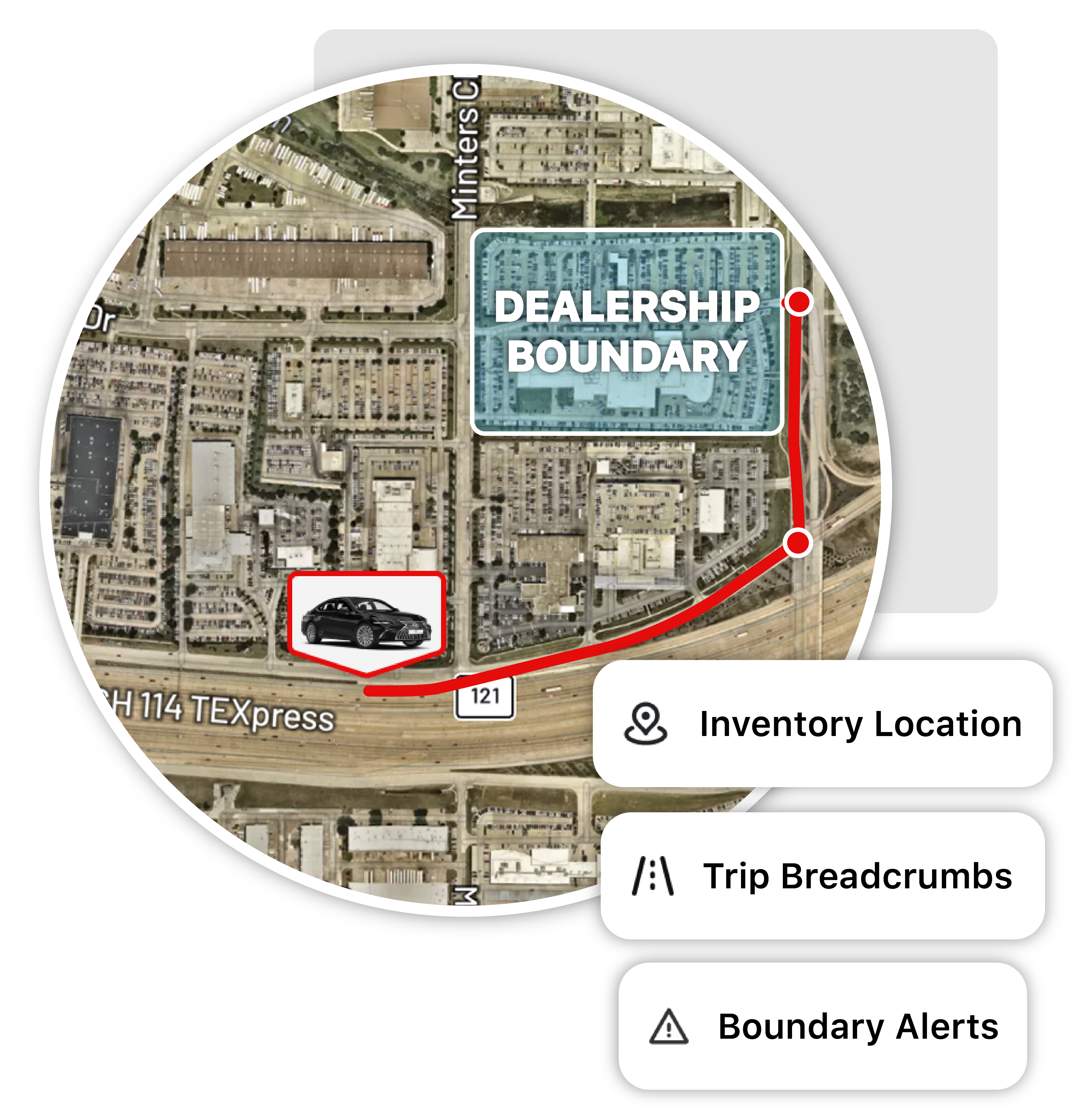
During an active transport theft, the speed of recovery dictates the outcome. If a vehicle is diverted during transit, logistics teams or consumer owners need the ability to immediately transition the device into a high-frequency tracking mode. Advanced systems allow managers to generate a secure, real-time tracking link during an active theft. This link can be instantly shared with law enforcement officers, allowing dispatchers and field units to view the vehicle's live location on any mobile browser without requiring specialized software or app installations.
Case Study: Internet Sale Intercept (Kentucky State Patrol)
The operational necessity of an independent secondary SVR platform is clearly demonstrated in a recent real-world recovery involving an internet sale intercept.
An Ikon Technologies dealer finalized an out-of-state internet sale, shipping the vehicle from New York to a customer in Oklahoma. While the transport truck was en route, the dealership’s finance team uncovered fraudulent documentation tied to the deal. Recognizing the imminent loss of a high-value asset, the dealer attempted to track the vehicle using the factory-installed original equipment manufacturer (OEM) telematics system, only to discover the perpetrators had already located and disabled it.
With the OEM tracking compromised, the dealer contacted Ikon Technologies. Because the vehicle was equipped with an independent, robust Ikon GPS solution, the tracking hardware remained fully operational and undetected. The Ikon team located the vehicle instantly, identifying that the transport carrier was currently moving through Kentucky.
Ikon's monitoring team provided real-time, continuous tracking coordinates to the Kentucky State Patrol. State troopers successfully intercepted the transport vehicle, directing the carrier to pull over into a church parking lot. Law enforcement verified the fraudulent nature of the shipment, ordered the stolen vehicle to be unloaded from the transport carrier immediately, and secured the asset. The vehicle was safely returned to the dealership's inventory, completely mitigating a total financial loss.
Key Takeaway for Dealers: Factory OEM telematics are often the first systems targeted and disabled during sophisticated fraud or theft schemes. True asset protection requires a secondary, resilient tracking solution with dedicated law enforcement recovery support.
Securing the Future of Automotive Transit
The 1,400% increase in vehicle transport theft is a direct challenge to the modern automotive sales and logistics model. As criminals lean heavily on technology, fraudulent carrier practices, and phishing tactics to intercept dealer trades, network transfers, and consumer shipments, the automotive industry must respond with equal technological sophistication and rigid standard operating procedures.
By upgrading to covert, continuously powered secondary tracking units and enforcing strict verification steps at the point of transit, dealership groups and consumers alike can shut down the vulnerabilities that transport thieves rely on.