The automotive retail landscape presents a critical structural paradox for franchise car dealers. Fixed operations departments have recently achieved historic revenue milestones, with the average dealership service and parts revenue reaching approximately $9.23 million in 2025.
This contraction represents a severe customer retention crisis, particularly among buyers of late-model vehicles. In 2025, only 54% of owners of vehicles two years old or newer returned to their selling dealership for service. This is a precipitous decline from the 72% retention rate recorded in 2023, showing that dealerships are failing to secure the loyalty of nearly half of their newest customers. This drop undermines the long-term sales pipeline, as vehicle owners who service their cars at a dealership are 30 percentage points more likely to repurchase their next vehicle from that same store. In fact, 88% of consumers state that their service experience directly impacts their likelihood to purchase a vehicle from that dealer again in the future.
The broader economic consequences of failing to retain these buyers are immense. Historical automotive benchmarks presented by General Motors at the National Automobile Dealers Association (NADA) demonstrate that a mere 1% increase in sales retention translates to approximately $700 million in annual revenue for the manufacturer, which equates to an average of $150,000 in localized revenue per individual dealer. When service lanes fail to capture the first-time buyer, the dealership loses both the immediate repair order revenue and a high-probability future vehicle sale. Currently, 20% of new car buyers actively want to service their vehicle at the selling dealership, yet only 8% actually have that first service appointment scheduled at the point of delivery. This represents a critical breakdown in cross-departmental integration, which is further highlighted by the fact that only 4% of service customers are offered a trade-in value during a service visit, despite 8% expressing a high interest in a trade-in opportunity.
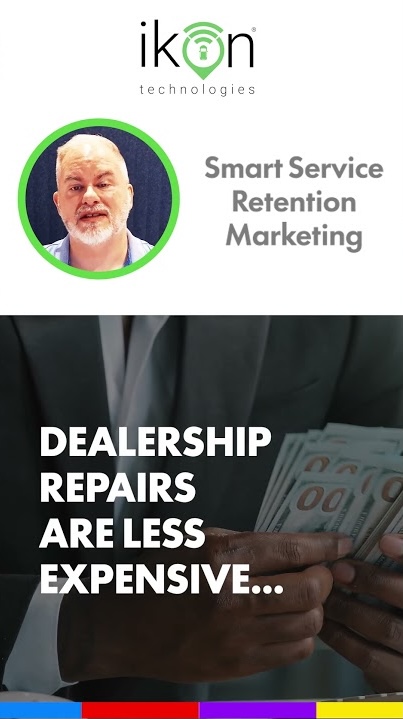
To build an effective service retention strategy, franchise car dealers must dismantle the prevailing myth that customers defect to independent repair shops primarily due to pricing. Market data reveals that the average dealership repair cost in 2025 was $261, whereas general independent repair shops charged an average of $275. Dealerships are actually less expensive on average than their aftermarket competitors, yet they continue to lose market share. Defection is driven not by the base cost of repairs, but by communication breakdowns, unexpected fees, scheduling friction, and trust deficits.
An analysis of customer defection reveals that nearly 45% of owners who defect to independent shops do so because of unexpected costs and poor communication. Transparency serves as a major trust builder in the service bay; dealerships that actively utilize video and photo validation to explain recommended repairs see a 53% increase in consumer trust and a 45% increase in customer engagement. This transparent communication directly drives higher repair order value, increasing the average ticket to $160 compared to $103 when video or photo validation is omitted. Furthermore, first-time fix rates represent a major vulnerability, as 12% of dealership repairs are not completed correctly on the first attempt. Of the customers who experience a botched repair, only 50% will return to the same facility, while 5% immediately defect to aftermarket providers.
Powertrain technology also influences service lane selection. Electric vehicle owners remain highly reliant on franchise dealerships, representing a 67% share of service visits. Hybrid owners also prefer dealerships at a 50% share, while traditional internal combustion engine owners maintain only a 28% share of dealer service visits. High-performing dealerships capitalize on these nuances by implementing robust interdepartmental technology. Fifty-eight percent of top-performing dealerships report stronger parts and service department integration with the overall dealership CRM, ensuring that the service lane functions as a key customer touchpoint.
Operational friction is another primary driver of customer defection. According to J.D. Power's 2025 Customer Service Index Study, mass-market vehicle owners wait an average of 5.2 days for a dealership service appointment, while luxury vehicle owners wait 5.4 days. Because of these delays, 35% of mass-market customers take their vehicle to an independent repair shop specifically because they can secure immediate service. While independent service centers routinely offer appointments just one day out, traditional dealership groups remain backlogged, offering appointments an average of four days out. This delay drives buyers into the aftermarket ecosystem where they are frequently lost forever.
This friction is compounded by a systemic breakdown in inbound phone operations. Industry data from early 2025 reveals that the average dealership hold time is 3 minutes and 5 seconds, resulting in a 31.8% abandonment rate where callers hang up before connecting with a live operator. Hold time benchmarks show that almost 60% of consumers hang up if kept on hold for just one minute, and more than 70% abandon the call entirely if hold times exceed three minutes. In contrast, top-performing dealerships utilize overflow systems and AI routing to drop calls with hold times longer than two minutes down to just 2%, compared to the 13% industry average.
The financial cost of these missed calls is substantial. The industry-average connection rate is just 65%, meaning one out of every three inbound calls never reaches a qualified individual. Approximately 32.3% of failed calls end up in a voicemail box, and 70% of those callers will call a competitor within thirty minutes of hanging up. Because 56% of dealership leads arrive after regular business hours, the lack of an automated or round-the-clock lead-capture system costs the average dealership over $1 million annually in lost revenue.
When dealerships do capture leads, internal handling remains highly inefficient. Approximately 43.2% of sales and service leads are mishandled, meaning they are missed, delayed, or never logged into the CRM at all. In fact, 14.1% of generated leads are never entered into the system. For customers who return to a dealership's website after reaching out, 65% receive no follow-up within twenty-four hours, and 61.6% are not contacted for eight or more days. This delayed response is highly damaging because 60% of buyers purchase a vehicle within three days of starting their search.Furthermore, while 61% of stores respond to leads within fifteen minutes, the quality of these responses is often low, with 91% excluding payment details, 90% omitting photos, 74% excluding price quotes, and 89% omitting alternative vehicle selections.
These operational failures extend directly into the physical showroom and service department. While nine out of ten customers who are greeted immediately rate their visit as "extremely positive," satisfaction drops to 67% if the greeting is delayed by twenty-one minutes or more. More than three-quarters of car buyers state that the test drive sold them on the vehicle, yet over half are forced to wait extended periods to actually take one.
This friction is reflected in dealer Net Promoter Scores: visits under two hours generate lower ratings due to a rushed feel, while satisfaction peaks at two to three hours and drops off severely if the transaction exceeds three hours. Reputation management suffers as a result, with 71% of consumers refusing to consider a business rated below three stars. This occurs in an environment where general trust in online reviews has plummeted to 42%, down from 79% in 2020, making active, high-quality customer experience management essential.
To bypass these scheduling, communication, and operational hurdles, franchise car dealers are shifting away from traditional, calendar-based CRM blast emails and adopting connected car telematics. By utilizing advanced, hardwired GPS hardware installed on consignment, dealerships can transition their tracking capabilities from pre-sale lot management to an ongoing, post-sale customer retention engine. Hardwired systems generate high-velocity, real-time data, whereas wireless options offer slower tracking speeds to preserve battery life and lack telematics capabilities. This high-velocity data provides dealerships with continuous visibility while delivering a premium white-labeled service to vehicle owners.
This post-sale connection is maintained through a custom, dealer-branded mobile application that keeps the dealership’s brand on the customer's phone screen. Unlike generic OEM portals or third-party tracking apps, this white-labeled solution displays the dealership's name and logo, building brand visibility through up to fifteen customer interactions per month.
The app provides vehicle owners with real-time location tracking, winter battery health alerts, speeding warnings, geofencing capabilities, and direct, single-click service scheduling. By offering these premium safety features with "no monthly fee," sales teams can easily overcome buyer hesitation, driving a 67% average dealer penetration rate and generating an average incremental Profit-Per-Vehicle-Retailed (PVR) of $323.
The consumer value proposition of this connected car technology is confirmed by dealership survey data. In an April 2026 consumer survey of 400 active app users, 70% of respondents stated they were more likely to return to the selling dealership for service because of the dealer-branded app on their smartphone. The real-time telematics link also allows dealerships to replace calendar estimates with actual vehicle diagnostics, transforming how stores manage post-sale communication and retention.
Ikon Technologies offers a dealer-built telematics platform designed to streamline operations across sales, finance, and fixed operations. The platform integrates lot management, consumer telematics, and automated marketing into a unified system that tracks vehicles from initial receipt through delivery, and back to the service drive. During pre-sale lot operations, Ikon's "Find the Car, Find the Keys" technology solves common sales-floor delays. This system reduces buyer wait times by 45 minutes, cuts key replacement costs by 95% (saving an average of $2,000 per month), and enables a rapid 22-minute average stolen vehicle recovery time. These operational efficiencies protect front-end gross margins while delivering a seamless purchase experience that supports long-term customer loyalty.
When a vehicle is sold, the hardwired GPS unit is registered to the buyer through the dealer-branded app, creating an F&I product with zero chargeback risk. While traditional vehicle service contracts face a high risk of cancellations and refunds, the Ikon telematics system is categorized as a permanent, non-cancellable accessory on the sales addendum, securing front-end margins on the day of sale.
This permanent accessory classification eliminates lender holdbacks, allowing dealerships to receive 100% of their profit instantly upon funding. Additionally, the F&I department can offer a term wrap option to match the customer's loan term, achieving an average 30% wrap rate that further increases PVR. Ikon also protects the dealership with up to $10,000 dealer deductible for on-lot theft, identity theft, and fraud.
For consumers, the app includes a $10,000 limited driver theft warranty. Crucially, $8,000 of this benefit must be spent directly at the originating dealership for a replacement vehicle, ensuring that if a customer's car is stolen, they are financially incentivized to return to the selling store.
To support international scalability, Ikon partners with 1NCE to deliver vehicle data to the cloud. This partnership provides the high-data IoT connectivity, security, and global coverage necessary to support Ikon's expansion across the United States, Canada, and Latin America.
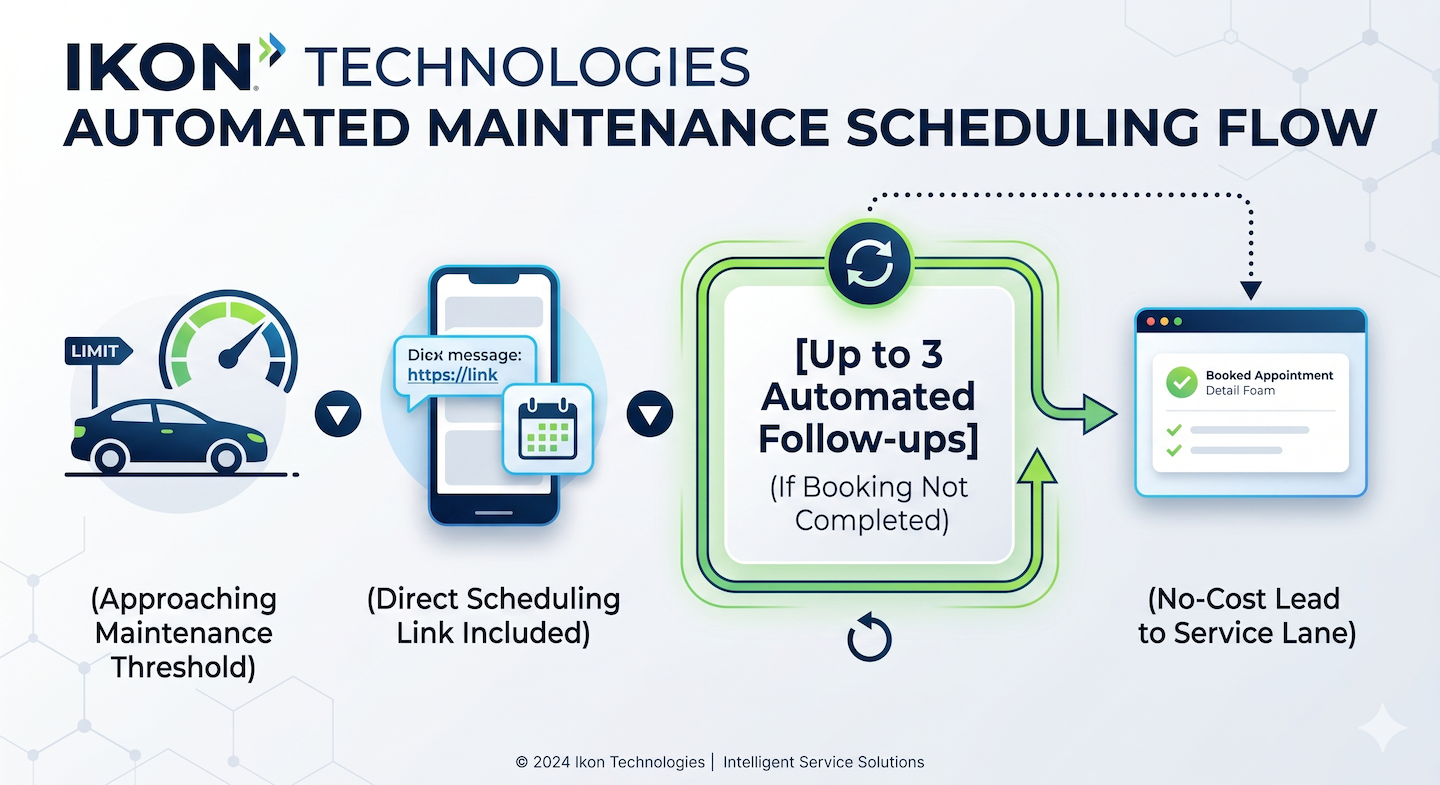
The foundation of Ikon's retention system is its Smart Marketing platform, which leverages real-time GPS mileage data to automate service lane outreach. By replacing generic calendar-based campaigns with actual vehicle usage data, the platform eliminates the guesswork from service reminders.
The system utilizes the hardwired GPS hardware to monitor real-time mileage and automatically identify when a vehicle's VIN is approaching a key maintenance threshold. This precise tracking forms the basis of a highly structured, automated service campaign designed to convert vehicle data into service lane appointments.
This automated outreach operates through a sequential, four-step retention loop :
This data-driven approach delivers measurable improvements in fixed operations performance. Dealerships using Ikon Smart Marketing achieve an average campaign response rate of 32.7%, bringing in more than 50 incremental repair orders (ROs) per month per store.
By maintaining a continuous digital connection with the customer, dealerships see a 74% higher repurchase rate for new vehicles among retained owners. Furthermore, dealers can easily customize their campaigns to include specific parts specials or seasonal promotions by coordinating directly with their dedicated Ikon Account Manager.
The practical value of this integrated platform is reflected in testimonials from dealer partners. Steve Fly of Metro Mazda Mesquite notes that the platform has built his brand and business far more effectively than traditional, third-party marketing, driving measurable revenue. Damon Rousell of Bellevue Nissan reports that the timely, mileage-triggered campaigns have significantly increased returning customer volume and engagement.
Niko Armijo of Corwin Ford praises the simplicity of Ikon's automated retention tools, citing a measurable boost in repeat business. Additionally, Allen Masengill of South County Chrysler Jeep Dodge Ram highlights that implementing Ikon’s telematics solutions increased their average profit-per-vehicle-retailed by $300, making it a valuable addition to the store's bottom line.
Maximizing service retention in a highly competitive market requires franchise car dealers to move past outdated, disjointed marketing tactics. The data from 2025 and 2026 shows that customer defection to independent repair shops is not driven by pricing, but by communication friction, long wait times, and a lack of transparency. To arrest this defection and protect the valuable post-sale relationship, dealers must integrate their sales, F&I, and fixed operations workflows into a single, cohesive retention loop.
By deploying advanced telematics solutions like Ikon Technologies, dealerships can establish a continuous, data-driven connection with their customers. Hardwired GPS units secure front-end F&I profitability with zero chargeback risk, while a dealer-branded mobile application keeps the store's brand on the customer's phone screen.
By using live mileage data to automate personalized service reminders, dealerships can eliminate scheduling friction, boost customer-pay repair orders, and maximize long-term service absorption rates. Ultimately, implementing an integrated telematics strategy allows franchise car dealers to turn the initial vehicle sale into a lifelong customer relationship, ensuring sustained profitability and growth across all departments.
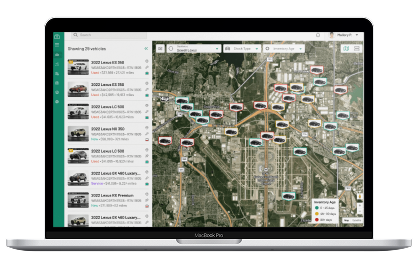
Master your lot. Locate cars and keys effortlessly to accelerate sales, check battery levels, run audit reports, view lot aging, all with no upfront device costs. We only make money when you do.
Ikon Lot Management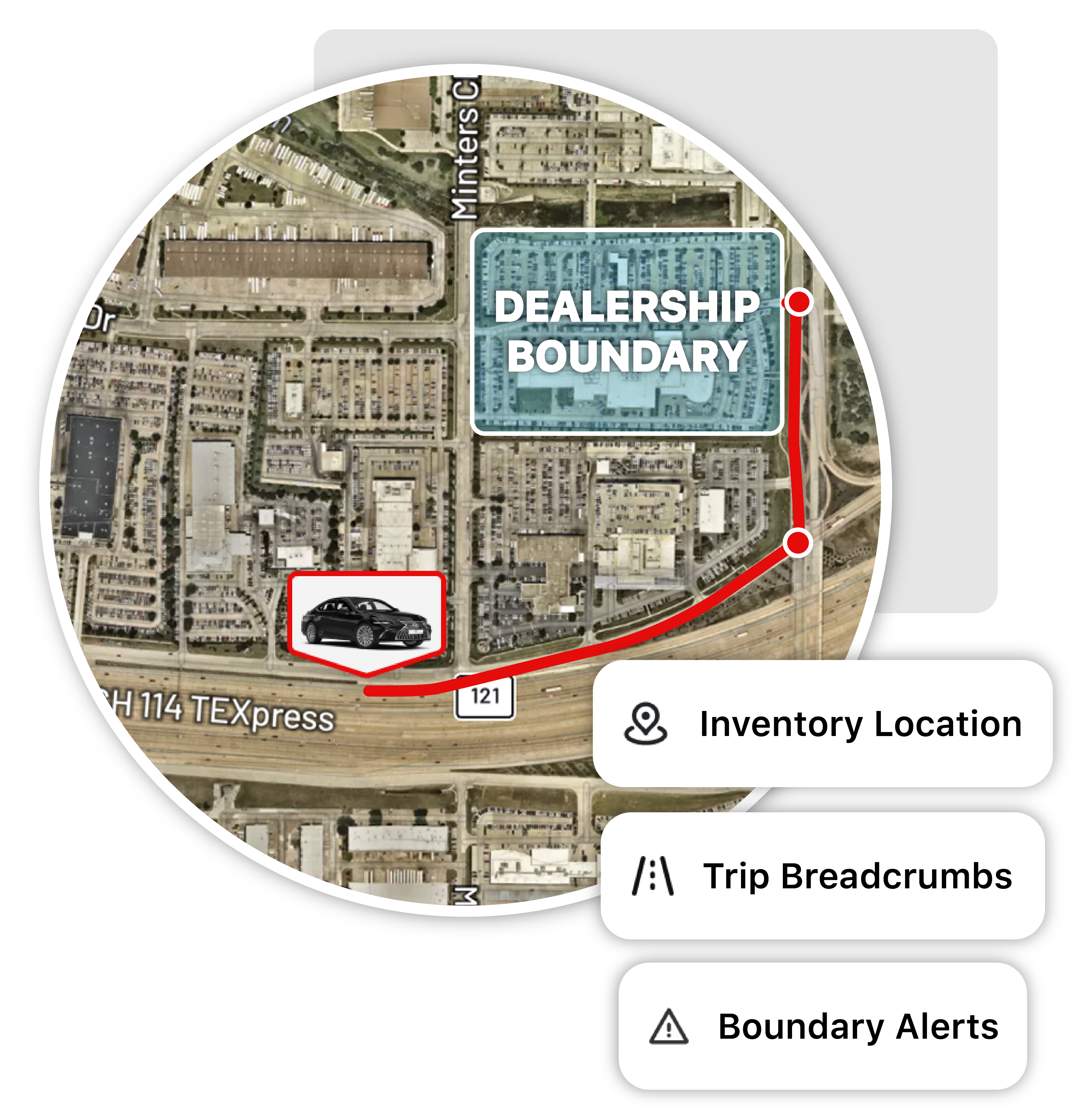
Stop inventory loss with near-real-time GPS tracking designed for rapid recovery. Ikon’s active theft recovery helps you secure your lot and lowers insurance premiums and deductibles.
Ikon Theft Recovery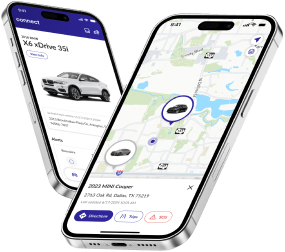
Get an avg. $323 PVR uplift by selling customers peace of mind and theft recovery featuring a $10,000 theft benefit. Your dealer-branded app keeps them connected to you, not the OEM.
Ikon Connected Car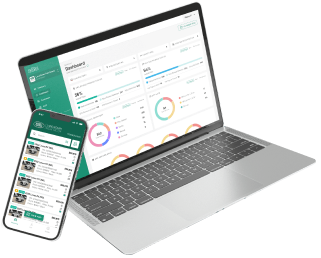
Maximize service retention and increase ROs with our mileage-triggered, automated text campaigns. We text customers at exactly the right time, driving them to your service scheduler.
Ikon Smart Marketing.jpg)




.jpg)