The Ikon Blog
The FTC’s New Pricing FAQs: Why Transparent Dealers Selling Connected Car Tech Have Nothing to Fear
.jpg)



.jpg)
On September 15, 2026, the Federal Trade Commission (FTC) published an official business guidance document: Automobile Industry Pricing Transparency: FAQs.
If your showroom installs vehicle telematics, inventory tracking, or aftermarket protection packages, you might immediately wonder: Is the FTC outlawing dealership add-on products? Do franchise dealers need to strip GPS solutions out of their vehicle lineup?
The clear, definitive answer is no.
A thorough analysis of the September 15 guidance confirms that the Commission is not targeting value-generating connected car platforms or legitimate automotive accessories. Rather, the FTC has laid down explicit, practical boundaries governing pricing prominence, advertising transparency, and clear consumer consent. For dealers operating with modern connected car platforms like Ikon Technologies, this guidance levels the playing field by eliminating deceptive competitor gimmicks while keeping high-value, transparent sales fully compliant.
The FTC's pricing guidance centers on one foundational pillar: the advertised headline price must be the actual price any walk-in buyer can pay to take ownership of the vehicle (excluding mandatory government charges like state sales tax, title, and licensing fees).
Here are the fundamental takeaways dealer leadership teams need to understand:
Actual Price Must Be Predominant (FAQs 2, 4 & 5): If a consumer cannot leave your lot without paying a specific fee or charge, that amount must be rolled directly into your advertised vehicle price. This applies uniformly across your website search results, vehicle detail pages (VDPs), third-party marketplaces, print, and social media ads.
Crucially for Fixed Ops and F&I leadership, FAQ 9 addresses optional protection packages and aftermarket products directly:
"Dealers can also offer additional options such as protection packages, accessories, or other goods and services as long as they do not mislead consumers."
The FTC outlined four specific red lines that constitute illegal deception under Section 5:
The ripple effect of the 97 warning letters sent to automotive dealership groups left many operators wondering if selling vehicle accessories had suddenly become a regulatory trap. But looking at the violations cited reveals a pattern of egregious, avoidable practices.
The dealerships targeted were advertising unrealistically low vehicle prices to win rank on third-party digital portals, only to spring mandatory $1,200 to $2,500 charges once buyers walked into the showroom - often calling them "mandatory dealer prep," "electronic filing addendums," or "non-negotiable GPS protection."
When a buyer is told, "The online price was $31,500, but our store policy requires everyone to pay $33,495 because the tracker is already on the car," that is a direct violation of federal law. Offering a premier connected car solution - either built cleanly into your transparent headline price or presented transparently as an opt-in consumer amenity - is completely lawful.
Dealerships use connected hardware for two core operational functions: dealer lot logistics (inventory location, battery monitoring, lot security) and customer connected safety (theft recovery, family tracking, vehicle health, service scheduling). Here is how you can structure your sales model under the September 15 FTC FAQs:
Presenting consumer tracking and stolen vehicle recovery as an optional add-on during the desk or finance conversation.
Equipping every vehicle with a base term (e.g., 6-month inclusive theft protection, connected mobile app and limited deductible warranty).
The FTC's specific warning against claiming that an installed accessory "cannot be deactivated or removed" strikes at the heart of older, legacy GPS setups. When an outdated device requires cutting wires and slicing under dash panels, desk managers dread pulling it out - creating high-pressure sales arguments that violate FTC rules.
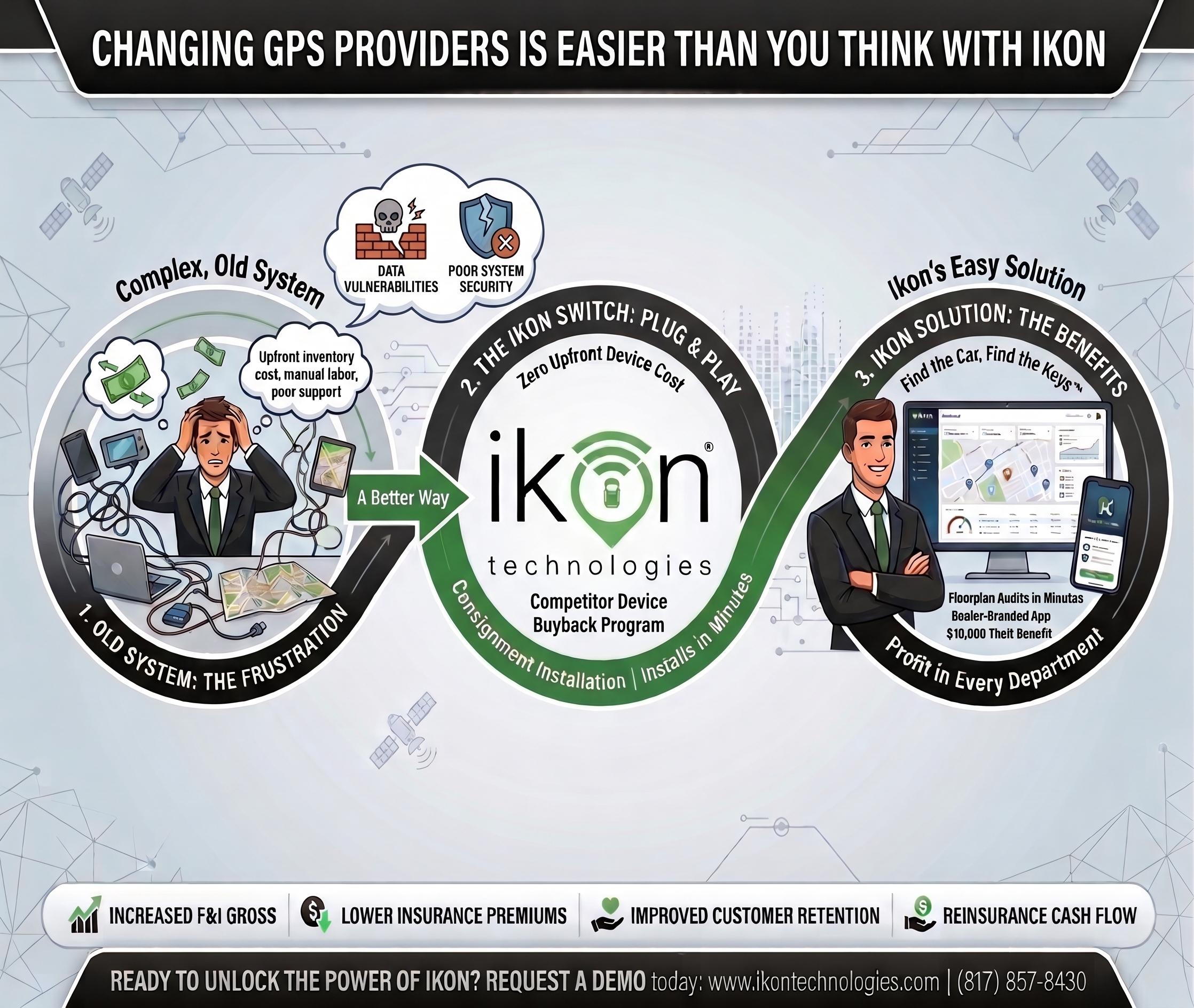
Ikon Technologies was engineered specifically around clean installation and flexible software provisioning, removing this operational bottleneck entirely:
| FTC Guidance Concern | Legacy GPS Systems | The Ikon Technologies Standard |
|---|---|---|
| "Cannot Be Removed" Claims (FAQ 9) | Permanent wire-tap installations that take 45 minutes of technician labor to pull out if declined. | Clean, non-invasive installation that can remain safely dormant or be swapped without wiring harness alteration. |
| Software Deactivation vs. Teardown | Physical unit must be removed to turn off services; leads to showroom disputes. | Instant digital provisioning: if a buyer declines consumer services, lot management simply stays active for the store while consumer tracking remains inactive. |
| Demonstrating Real Value | Infrequent 15-minute tracking pings that provide minimal real-time consumer utility. | Real-time telematics, continuous tracking, nationwide recovery, and a dealer-branded service portal driving Fixed Ops retention. |
| F&I Process & Pricing | Unclear secondary stickers taped beside the Monroney with ambiguous charges. | Transparent itemization, distinct contract terms, and frictionless digital consent built for modern F&I menus. |
To protect your franchise store against regulatory exposure while maintaining healthy backend and accessory gross profit, implement these 4 procedural controls today:
The FTC's September 15 FAQs are not a hurdle for honest dealers - they are a roadmap for professional operations. By committing to upfront pricing, transparent menus, and intelligent connected car technology that delivers genuine security to vehicle owners, your dealership can operate with complete regulatory confidence.