
.jpg)


.jpg)
Most dealership managers have searched online for "vehicle key management" at some point and landed on consumer articles about lost key fobs, Bluetooth tags, and whether car keys contain built-in locators. That content is written for drivers, not for the person managing 200 fobs across a busy lot.
Most dealership managers have searched online for "vehicle key management" at some point and landed on consumer articles about lost key fobs, Bluetooth tags, and whether car keys contain built-in locators. That content is written for drivers, not for the person managing 200 fobs across a busy lot.
The confusion it creates is real, and it costs your store time and money every week. This article breaks down what vehicle key management means in a dealership context, why traditional methods fall short, and how modern connected car technology closes the gap.
ikon Technologies helps dealerships solve this exact problem by pairing real-time vehicle locating with key-level visibility across every department. Below, you'll find a practical look at the operational challenge, where consumer advice breaks down, and what a dealer-specific approach looks like on the ground.
At a dealership, key management is an operational workflow, not a consumer convenience feature. It means knowing exactly which employee has which key, when they checked it out, and when it needs to come back. Every key checkout ties a named person to a specific vehicle record with a timestamp and a return deadline.
When that chain of custody breaks, the ripple effects hit multiple departments. A missing key can stall a test drive, delay a service pickup, or keep a reconditioning unit waiting on the wrong rack.
According to NICB's 2025 reporting, vehicle theft remains a persistent concern even as national numbers decline. That makes physical key security a front-line priority for every store.
Search for "can car keys be located" and you'll find pages recommending Bluetooth tags, Apple AirTags, and smartphone apps. Those answers work fine for a driver who left a fob in a coat pocket.
They do not address a dealership environment where dozens of employees handle hundreds of fobs daily across sales, service, recon, and loaner departments.
The core issue is scale. A consumer needs to find one key. A dealership needs to account for every key, every handoff, and every return, all day long. Bluetooth tags designed for personal use lack the range, the multi-user accountability, and the lot management integration that a commercial operation requires.
| Capability | Consumer Tags (AirTags, Tiles) | Fleet Key Systems | ikon Connected Dealership |
|---|---|---|---|
| Primary Focus | Single-user personal items | Scheduled driver compliance | Multi-department inventory turnover |
| Lot-Wide Range | Short-range crowd mesh | Stationary cabinet readers | Real-time lot & key mapping |
| Handoff Accountability | None (personal device locked) | Logs checkout, not physical location | Active user timestamps & live position |
| DMS / Inventory Link | No integration | Limited fleet management link | Synced directly by Stock # & VIN |
No. The vast majority of key fobs, including modern smart keys with keyless entry, do not include built-in location components. A key fob communicates with your vehicle's immobilizer system over a short range, but it does not broadcast a locatable signal on its own.
This is a critical distinction for dealership managers. Fob-to-car communication confirms the key is authorized to start the vehicle. It does not tell you where the key is sitting on your lot.
That gap is precisely where dealerships lose visibility. It is the reason a purpose-built key locating system matters more than a personal Bluetooth tag.
Many franchise dealerships spend upwards of $50,000 per year replacing misplaced smart keys and key fobs. At $300 to $500 per modern smart key, with luxury fobs running even higher, a five-key-per-month average becomes a significant line item against gross profit.
The replacement bill is only the visible cost. When a salesperson spends 15 or 20 minutes searching for a fob, that's a customer waiting at the desk. A CDK Global study found that 55% of car shoppers reported waiting too long during the test drive process. Miss that window, and the customer walks.
Service departments absorb losses too. Technicians losing even 10 minutes per day to key searches adds up to thousands in unbilled labor hours annually. That is pure fixed-ops leakage your service department can recover with the right system in place.
Fleet operations and dealerships both need key accountability, but the workflows differ. Fleet key control focuses on scheduled vehicle assignments and return compliance across a stable driver pool.
Dealership key management is messier. Keys move between salespeople, porters, service advisors, detail crews, and recon technicians throughout a single day.
That constant handoff cycle is where visibility breaks down. A salesperson grabs a fob for a hot prospect, the prospect reschedules, and the key ends up in a desk drawer instead of back in the cabinet.
The checkout log says the key is with one person while it's physically somewhere else entirely. Dealerships need a system that locates the key itself, not just the last person who signed it out.
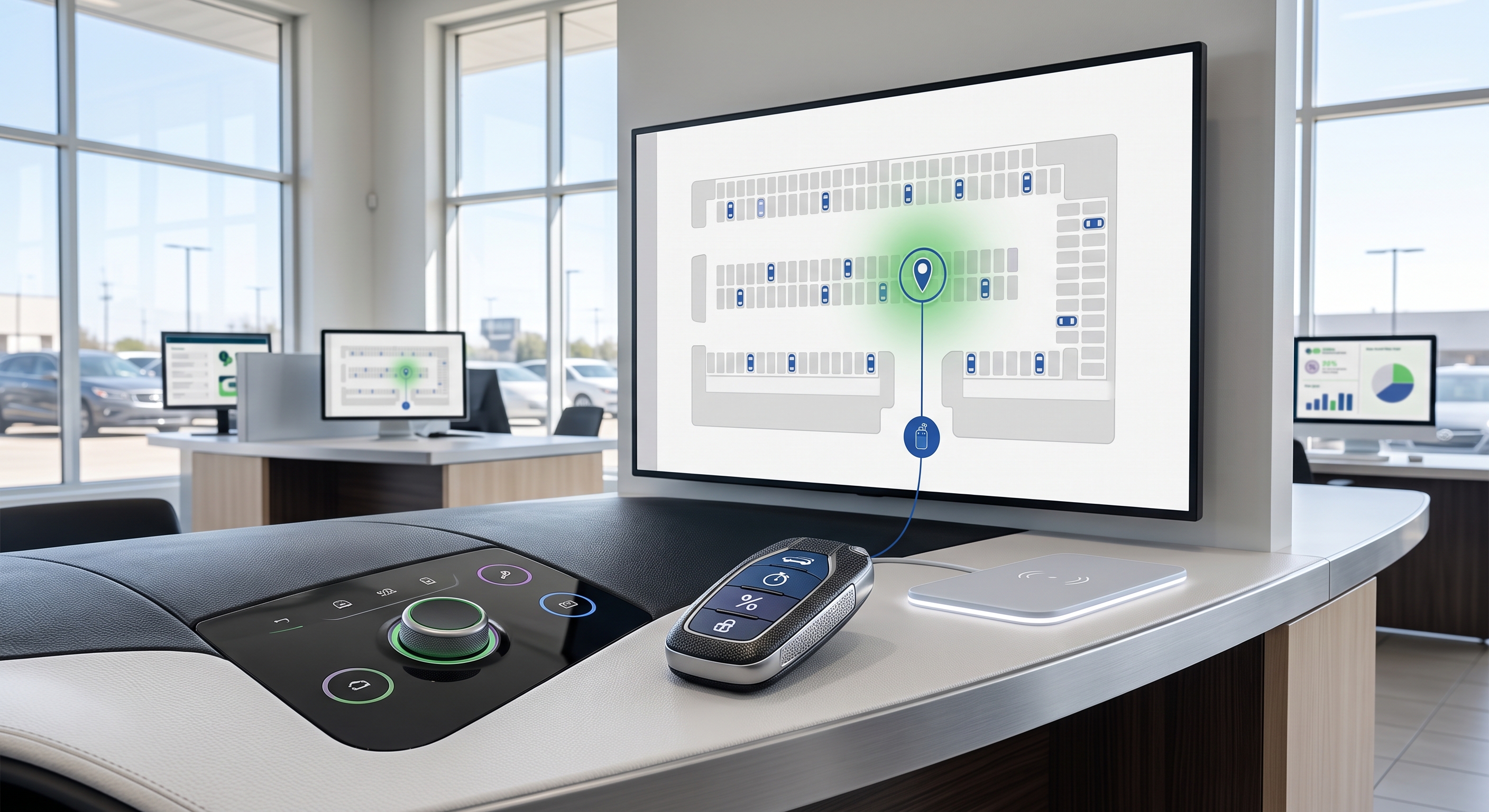
ikon Technologies addresses this challenge with its Find the Car, Find the Keys capability. Every vehicle on your lot carries a connected device, and every key is tagged so its position ties back to the same dashboard your sales and service teams already use.
A salesperson pulls up a stock number, sees the vehicle in row F, slot 12, and the dashboard shows exactly where the fob is located. No radio call to the porter. No second trip back to the front desk.
This approach saves an average of 15 minutes per sale and reduces floor plan audit time by 56%.
Because the key location data lives inside ikon Technologies' broader connected car platform, the same login that handles theft recovery, battery monitoring, and customer engagement also runs the daily key lookup. Your team gets one unified view instead of switching between separate systems for separate problems.
Technology amplifies whatever process is already in place. Drop it onto a disorganized workflow and you get a faster way to confirm that nobody knows where the key went. The stores that see the biggest return from connected lot management tighten their handoff rules first.
Every key checkout gets logged directly to a named employee record with a firm timestamp.
Test-drive returns flow through one designated central drop point, eliminating desk-drawer stashing.
Service writers confirm key-in-hand before the customer departs the service drive.
Sales managers run an automatic daily exception audit for any fob out longer than 120 minutes.
Once those rules are clear, the real-time location layer stops being a gadget and starts being the accountability tool your managers actually review. A porter who knows the dashboard shows who pulled a specific fob at 2:47 p.m. handles that key differently than one who knows the pegboard never gets checked.
The consumer internet is full of advice about locating lost car keys. Almost none of it applies to the operational reality of running a dealership lot with hundreds of units and dozens of employees.
Standard fobs don't broadcast their position. Bluetooth tags built for personal use can't scale to a commercial environment. And legacy key cabinets only tell you who checked a key out, not where it ended up.
Closing that gap requires a dealer-specific approach that pairs key locating with vehicle visibility, employee accountability, and process discipline. That is the difference between searching and knowing, and it is the foundation ikon Technologies was built on by dealers, for dealers.
No, standard car key fobs do not include built-in location components. They communicate with the vehicle's immobilizer over a short range but cannot broadcast a locatable signal independently.
Dealerships need a purpose-built system to locate keys on the lot. ikon Technologies' Find the Keys feature tags each fob and maps its position to a shared dashboard in real time.
Keys move between multiple employees and departments throughout the day. Salespeople, porters, service advisors, and detail crews all handle fobs, creating constant handoff points where visibility breaks down.
Without real-time key locating, a single missed return can cascade into search time, stalled deals, and replacement costs that add up fast.
ikon Technologies tags every key and pairs its location with vehicle position data on one dashboard. Your team can pinpoint any fob in seconds instead of walking the lot or hunting through desk drawers.
This approach saves an average of 15 minutes per sale and reduces floor plan audit time by 56%, turning key management from a daily headache into a resolved workflow.
Consumer Bluetooth tags like AirTags work for finding a personal key fob at home. They lack the multi-user accountability, lot-wide range, and inventory integration a dealership requires.
A dealer-specific system connects key location to vehicle records, employee checkouts, and your service retention workflow, which a consumer tag cannot do.
Start by enforcing a simple rule: every key checkout gets logged to a named employee with a return deadline. Once that discipline is in place, pair it with real-time key locating to close the gap between the log and physical reality.
ikon Technologies makes this practical with a dashboard that shows every key and vehicle position across your lot, so your team spends time selling instead of searching.