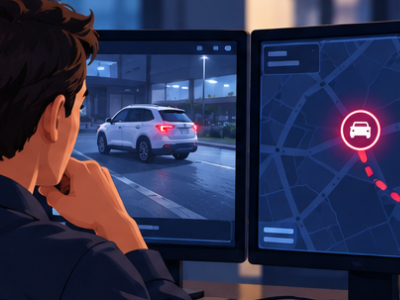
Dealer Theft Defense Playbook

The threat changed. Your defense should too.

How Organized Crime Syndicates Infiltrate Franchise Lots, and the 5-Pillar Operational Framework to Protect Your Inventory

Executive Summary

The Street-Theft Paradox

The latest release of vehicle theft data from the National Insurance Crime Bureau (NICB) presents what appears, at first glance, to be welcome news: national vehicle theft rates have declined by more than 20% year-over-year.

Targeted law enforcement task forces, cross-border container seizures, and software patches for vulnerable mass-market platforms have curbed opportunistic, amateur street theft.

For U.S. franchise auto dealers, however, the real-world reality on the ground tells the opposite story.

Organized crime syndicates, export cartels, and sophisticated fraud networks have not retired—they have pivoted. Blocked from easy street-side targets, professional theft rings have systematically shifted their focus up the supply chain to where high-value vehicles are concentrated in bulk: franchise dealership lots.

In Decline
-21%
Amateur street theft is down

Law enforcement, container seizures and software patches have made some traditional targets harder to exploit.

→
Rising Fast
Franchise lots become the target of organized crime syndicates

🚨 CAN Bus Injection & OBD-II Electronic Key Cloning
🚨 Synthetic Identity & Remote Straw-Buying Schemes
🚨 Coordinated Midnight Lot Sweeps & Gate Breaches
🚨 Rapid Consolidation to Port Containers (< 48 Hours)

The financial impact on dealerships extends far beyond the raw sticker value of stolen inventory. With commercial garagekeeper insurance deductibles frequently climbing to $10,000, $25,000, or even $50,000 per occurrence, a single multi-unit raid can trigger catastrophic loss ratios, lead to policy non-renewals, and inflict unrecoverable floorplan balance liabilities.

This playbook provides dealer principals, general managers, and operational executives with an actionable blueprint to diagnose vulnerabilities across their physical perimeter, digital showroom, key room, and lot logistics—and deploy an active defense before vehicles disappear into international supply chains.

Part ONE

Deconstructing the Modern Threat Matrix

To build an effective defense, dealership management must first understand the operational anatomy of modern lot thefts. Traditional "smash-and-grab" attacks have been replaced by four sophisticated vectors:

Vector #01

CAN Bus & OBD-II cloning

🚨 Exposure: Vehicles staged along front lines or parked overnight near service check-in bays are prime targets.
🔧 Method: Perpetrators target high-margin units (heavy-duty pickups, premium muscle cars, luxury SUVs). Using commercially available hardware originally developed for emergency locksmiths, thieves access the vehicle’s Controller Area Network (CAN) bus—often by popping headlights or accessing wiring harnesses beneath front wheel wells—or plugging directly into the internal OBD-II diagnostics port.
⏱️ Speed: A blank key fob can be programmed to a vehicle's onboard immobilizer system in under 75 seconds, bypassing factory anti-theft sensors completely without triggering an audible alarm.
Vector #02

Synthetic Identity & Digital Retailing Straw Buys

Execution: The "buyer" arranges an off-site delivery or hires a third-party auto transporter to pick up the vehicle, often on a busy Friday evening or Saturday morning when sales desks are overwhelmed.
🔧 Method: Criminal syndicates create synthetic credit identities using real Social Security Numbers belonging to minors or deceased individuals, paired with synthetic names, falsified pay stubs, and VoIP phone numbers. Using dealership digital retailing portals, these buyers submit online applications, secure fast approvals through automated lender algorithms, and complete remote paperwork.
Result: The dealership does not realize a theft has occurred until 30 to 45 days later, when the lending institution issues a first-payment default, discovers the fraudulent profile, and demands an immediate, full-balance vehicle repurchase.
Vector #03

The "Dummy Fob" Switch (Sales & Service Drives)

Method: An operative visits the showroom posing as an active, qualified customer requesting an unescorted test drive, or takes advantage of a salesperson stepping away during a vehicle walk-around.
Swap: The operative swaps the genuine factory key fob with a physically identical, deactivated counterfeit fob.
Heist: The operative returns the dummy fob to the salesperson and leaves. Later that night, accomplices return to the lot, unlock the genuine vehicle using the retained factory fob, and drive off without triggering alarms or forced-entry damage.
Vector #04

Coordinated Midnight Sweeps & Transport Interception

Method: Professional crews of four to six individuals hit dealership holding compounds and remote prep lots between 2:00 AM and 4:00 AM. They use heavy vehicles to ram perimeter barriers or tow vehicles away directly.
Timeline: High-demand vehicles are staged in secluded warehouse parking lots or industrial shipping yards for a "cooling off" period of 12 to 24 hours to check for rudimentary tracking tags. Once cleared, they are loaded into intermodal shipping containers, sealed, and manifested under false export documentation.
Part TWO

12-point vulnerability audit

Before implementing new countermeasures, conduct this 12-point diagnostic across your sales, service, and inventory operations.

Full diagnostic

Complete the audit to build your diagnostic

Your result updates continuously as you assess the 12 dealership controls.

Recommended next steps

  • Open the first domain and begin assessing your controls.
Part THREE

The 5-pillar dealer defense framework

Securing a modern dealership requires an integrated operational ecosystem spanning physical barriers, identity verification, key governance, and active telematics.

01

Perimeter hardening & lot choreography

Physical perimeter defenses buy critical time. Make unauthorized entry physically and logistically difficult:

  • Strategic Anchor Parking: Park high-profile target units (V8s, high-trim SUVs, performance sedans) deep inside the lot perimeter. Block exit lanes and lot gates overnight using lower-risk, heavyweight inventory (such as service loaners, commercial chassis cabs, or older trade-ins) parked in interlocking patterns.
  • Eliminate Blind Staging Zones: Relocate the reconditioning staging area, off-lease drop-off, and transport delivery bays to well-lit zones covered by continuous-recording, high-definition perimeter cameras.
  • Motion-Triggered Lighting & Audible Deterrents: Standard constant yard lighting often provides thieves with ideal working illumination. Deploy motion-activated, high-lumen floodlights paired with automated strobe/audio warnings that trigger when perimeter boundaries are breached after hours.
02

Digital identity verification

Close the synthetic identity and remote fraud loopholes at the digital sales desk:

  • Mandatory Dynamic Identity Verification: Eliminate passive PDF ID submissions. Require all remote buyers to complete a real-time biometric identity verification session (e.g., scanning a physical driver’s license with live liveness-detection selfie technology) prior to issuing desking numbers or sending contracts.
  • Third-Party Transport Verification: Never release a vehicle to a carrier without:
    - Direct carrier verification through Central Dispatch or carrier insurance portals.
    - A signed, notarized bill of lading matching the exact name and credentials of the driver.
    - Clear physical inspection photos showing the driver's face, commercial license, and truck USDOT number.
  • "Red Flag" Delivery Protocols: Require all digital retail deliveries shipped to residential addresses to be delivered during daylight hours, with direct physical signature and in-person card/ID verification at the delivery destination.
03

Key vault hygiene & chain of custody

Eliminate key-related vulnerabilities across the showroom and service drive:

  • The "Two-Fob Rule" on Frontline Audits: For all modern push-button start vehicles, both factory key fobs must be cataloged in the electronic key vault upon inventory check-in. Never allow a vehicle to hit frontline status with one fob "floating" in a desk drawer.
  • Post-Test-Drive VIN Check: Institute a non-negotiable sales process: When a customer returns from a test drive, the salesperson must physically press the lock button on the returned fob while standing within range of the vehicle to confirm that the vehicle responds, verifying that the returned fob is genuine and active.
  • Service Key Security: Eliminate external, non-secure key drop boxes. Upgrade to hardened, steel, dual-baffle key drop depositories anchored into structural concrete, monitored directly by an isolated camera feed.
04

Active telematics & geofencing

Physical barriers and procedures can be breached. Real-time telematics provides the critical visibility required to turn a lot breach into an immediate, non-event recovery.

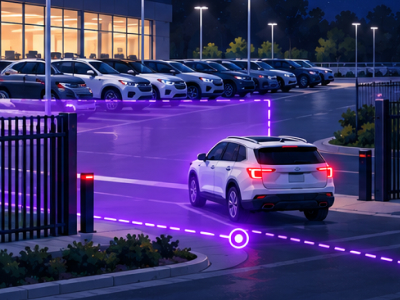
  • Automated Dynamic Geofencing: Passive GPS tracking (checking a location once every 24 hours) is obsolete against modern syndicates. Modern dealership operations demand active geofencing that triggers an instantaneous automated alert the moment a vehicle crosses dealership lot boundaries between the hours of 9:00 PM and 6:00 AM.
  • Tamper-Evident Architecture: Organized rings immediately check the OBD-II port. High-security telematics deployments (such as Ikon Technologies) utilize devices with internal backup batteries and power-disconnect alarms that trigger an emergency alert to dealership management the exact millisecond a unit is unplugged or tampered with.
  • Battery Voltage Health Monitoring: Low battery voltage is a silent inventory killer that also compromises security systems. Real-time battery monitoring ensures lot inventory does not sit dead, preventing the need to leave vehicles unlocked or keys on dashboards during jump-start runs.
03

Rapid-response law enforcement protocol

The first 60 minutes following an unauthorized vehicle departure determine whether a unit is recovered intact or loaded into an export container.

  • Deploy "Live Tracking Links": When reporting a stolen vehicle to law enforcement, providing static address updates over the phone is ineffective. Modern telematics platforms allow dealership operators to generate a secure, temporary, web-based tracking link directly for police dispatchers, enabling responding patrol units to track the vehicle's heading, speed, and real-time coordinates on mobile data terminals.
  • Pre-Drafted NCIC Asset Sheets: Maintain a standardized digital file for every vehicle in inventory containing the exact VIN, license plate/temp tag number, engine serial number, color, and telematics identifier. This allows dispatchers to enter the vehicle into the National Crime Information Center (NCIC) database within minutes, legally greenlighting highway patrol units to conduct a felony stop.
CRITICAL FIRST HOUR

Recovery is a race against logistics

The first 60 minutes following an unauthorized vehicle departure determine whether a unit is recovered intact or loaded into an export container. The response should be operationalized before an incident occurs.
Swipe through the response timeline
00:00

Vehicle crosses the geofence

An inventory vehicle crosses the dealership boundary after hours. The unauthorized movement becomes the trigger for the recovery protocol.

00:01

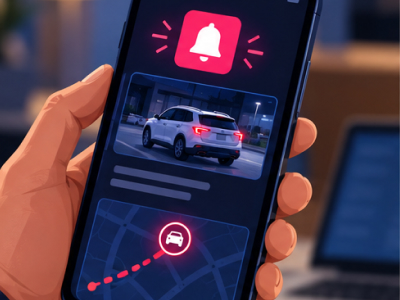
Automated alert is sent

The General Manager or asset-protection contact receives an immediate alert, reducing the gap between vehicle movement and human awareness.

00:03

Incident is verified

Management checks lot cameras and live telematics to rule out an authorized relocation and confirm that an active theft is underway.

00:05

Emergency dispatch is contacted

Law enforcement receives the theft report together with a live dispatch tracking link, giving responding officers current vehicle location data.

00:15

Patrol establishes visual intercept

Responding units use live GPS breadcrumbs to close the distance and establish visual contact while the vehicle is still actively moving.

00:45

Asset is intercepted & secured

The vehicle is recovered and impounded before it reaches port staging, completing the rapid-response sequence inside the critical first hour.

Part FOUR

The Financial Impact: Defending Your Floorplan & Deductibles

Operating an active inventory defense framework is an operational investment that protects dealership gross margins. Here is a scenario featuring a 3-Vehicle High-Line Truck Theft ($225,000 Total Value), comparing the financial on an unprotected Vs. actively managed lot.

Beyond preventing catastrophic single-event losses, establishing an active tracking and telematics standard across your lot provides immediate leverage during annual garagekeeper and floorplan insurance negotiations. Underwriters routinely offer credits, deductible reductions, or policy discounts to dealer groups with verified, active asset-tracking deployments.

Unprotected Lot Exposure

Insurance deductibles $45,000
Lost front-end + add-on gross $13,500
Floorplan interest $3,800
Estimated renewal surcharge $24,000
🚨− $86,300
Net dealership cash loss
→

Actively monitored lot Recovery

Vehicle recovered within 4 hours$0
Insurance deductibles $0
Damage / detailing $1,200
Retained front-end margin +$13,500
+$85,100
Net dealership benefit
DOWNLOAD

The 60-minute emergency vehicle recovery SOP

CHRISTOPHER <<<<This section should feel printable and operational. Add a “Download / Print SOP” action and consider a one-page branded PDF.>>>>

Download the SOP
1

Verify alert & rule out internal relocation

  • Review the alert timestamp, vehicle VIN, and current telematics location.
  • Confirm no transport carriers or authorized employees were scheduled to move the unit.
2

Activate Law Enforcement Dispatch

  • Call emergency 911 for the jurisdiction where the vehicle is currently moving, not just the dealership's physical address.
  • State clearly: "I am reporting an active, in-progress vehicle theft from [Dealership Name]. We have live, real-time GPS telematics tracking the vehicle."
3

Generate & Transmit Live Tracking Link

  • Open the asset management dashboard (e.g., Ikon Technologies).
  • Generate a temporary law enforcement tracking link.
  • Provide the URL to the dispatch supervisor or directly to responding officers.
4

Log Vehicle Details into NCIC

  • Provide the full 17-digit VIN, year, make, model, color, and dealer plate/temp tag.
  • Request the police incident report number immediately.
5

Notify Executive Management & Floorplan Carrier

  • Notify the General Manager and Controller.
  • Prepare the bill of sale, floorplan draft copy, and lot check-in sheet for insurance adjusters if recovery is delayed beyond 24 hours.